
Without a car
Umbria by train
18 towns
Towns in this region where we confirmed an active station. Check the timetable before you go: a station on the map is not the same as a useful service.
The towns
- Written about. No. 74.
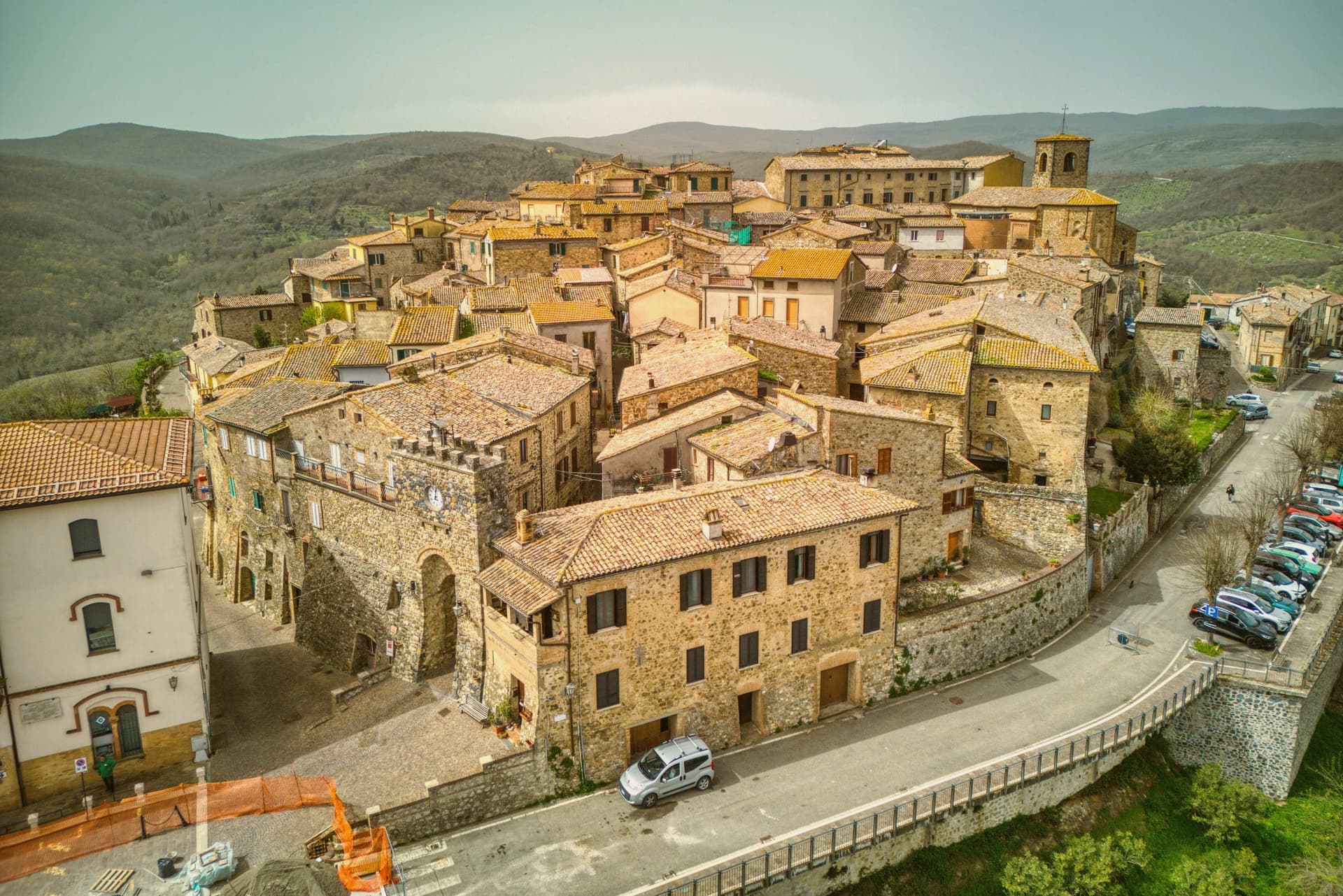
Allerona
Province: Terni · 472 m
A stone borgo at 472 meters between the Paglia valley and the Valdichiana, an Orvieto outpost whose Monaldeschi castle fell to Charles V.
- Written about. No. 62.
Assisi
Province: Perugia · 424 m
A pink limestone town at 424 meters on the western flank of a mountain above the plain, the birthplace of Francis and a UNESCO site since 2000.
- Written about. No. 77.
Campello sul Clitunno
Province: Perugia · 290 m
Springs of the Clitunno and the Lombard Tempietto on the valley floor at 290 meters, the temple inscribed by UNESCO in 2011.
- Written about. No. 59.
Castiglione del Lago
Province: Perugia · 304 m
Trasimeno's western promontory, once the lake's fourth island, fortified in 1247 and later frescoed for a marquis of Corgna.
- Written about. No. 78.
Città della Pieve
Province: Perugia · 508 m
A red-brick hill town at 508 meters above the Valdichiana, the birthplace of Perugino and the home of one of Italy's narrowest alleys.
Città di Castello
Province: Perugia · 288 m
A walled town of 38,000 in the upper Tiber valley where Raphael painted his first independent commissions and the white truffle season is the year's headline food event.
- Written about. No. 79.
Foligno
Province: Perugia · 235 m
A valley town at 235 meters on the Topino, where Dante's Divine Comedy was first printed in 1472.
Fossato di Vico
Province: Perugia · 581 m
A medieval village on Mount Mutali at 581 meters, where the Via Flaminia's Roman waystation Hellvillum became a tenth-century castle still threaded by covered alleyways.
- Written about. No. 60.
Magione
Province: Perugia · 299 m
A hill town east of Trasimeno built around a medieval Order's fortified base.
- Written about. No. 82.
Narni
Province: Terni · 240 m
Narni is a hilltop town on a travertine outcrop above the Nera valley whose Latin name, Narnia, gave C.S. Lewis a word for a fictional kingdom he never set foot in.
Nocera Umbra
Province: Perugia · 520 m
A hill town at 520 meters on the Apennine slope, leveled by the 1997 earthquake and rebuilt, with mineral springs flowing since the sixteenth century.
- Written about. No. 83.
Orvieto
Province: Terni · 325 m
Etruscan Velzna on a 325-meter tufa butte, later a medieval refuge of popes.
- Written about. No. 61.
Passignano sul Trasimeno
Province: Perugia · 289 m
A near-peninsula on the northern shore of Lake Trasimeno, on the road Hannibal closed when he ambushed the Romans in 217 BC.
Spello
Province: Perugia · 280 m
Augustan Hispellum sits at 280 meters on Monte Subasio, its Roman gates still standing over streets that Pinturicchio once painted a chapel for.
- Written about. No. 87.
Spoleto
Province: Perugia · 396 m
Lombard ducal capital at 396 meters under the Rocca Albornoziana, where a 230-meter aqueduct bridge crosses to Monteluco and Menotti founded the Festival in 1958.
- Written about. No. 88.
Terni
Province: Terni · 130 m
Umbria's second city, rebuilt around its steelworks, home of Saint Valentine and seven kilometers from the Cascata delle Marmore.
- Written about. No. 72.
Todi
Province: Perugia · 398 m
A walled hill town at 398 meters on the Tiber, with Etruscan, Roman, and medieval rings stacked one above the other.
- Written about. No. 90.
Trevi
Province: Perugia · 412 m
A walled town at 412 meters above the Spoleto valley, ringed by 200,000 olive trees that make it the Umbrian capital of olive oil.
From elsewhere in Italy
Five more towns
Realmonte
Province: Agrigento
The Agrigento coast commune with the white marl cliff of the Scala dei Turchi and a salt mine carved into 5-million-year-old halite.
Campi Salentina
Province: Lecce
A Salento plain town fifteen kilometers north of Lecce, rebuilt after the Saracen raids of 926 and later raised to a marquisate.
Bolsena
Province: Viterbo
A medieval town at 350 meters on the eastern shore of Europe's largest volcanic lake, where a Bohemian priest reported a Eucharistic miracle in 1263.
Vernole
Province: Lecce
A Salento commune ten kilometers from Lecce whose frazione of Acaya is the only Renaissance fortified town in southern Italy.
Santo Stefano Belbo
Province: Cuneo
A Belbo valley village at 175 meters between the Langhe and Asti hills, birthplace of Cesare Pavese and the largest producer of Moscato d'Asti.