
Without a car
Emilia-Romagna by train
17 towns
Towns in this region where we confirmed an active station. Check the timetable before you go: a station on the map is not the same as a useful service.
The towns
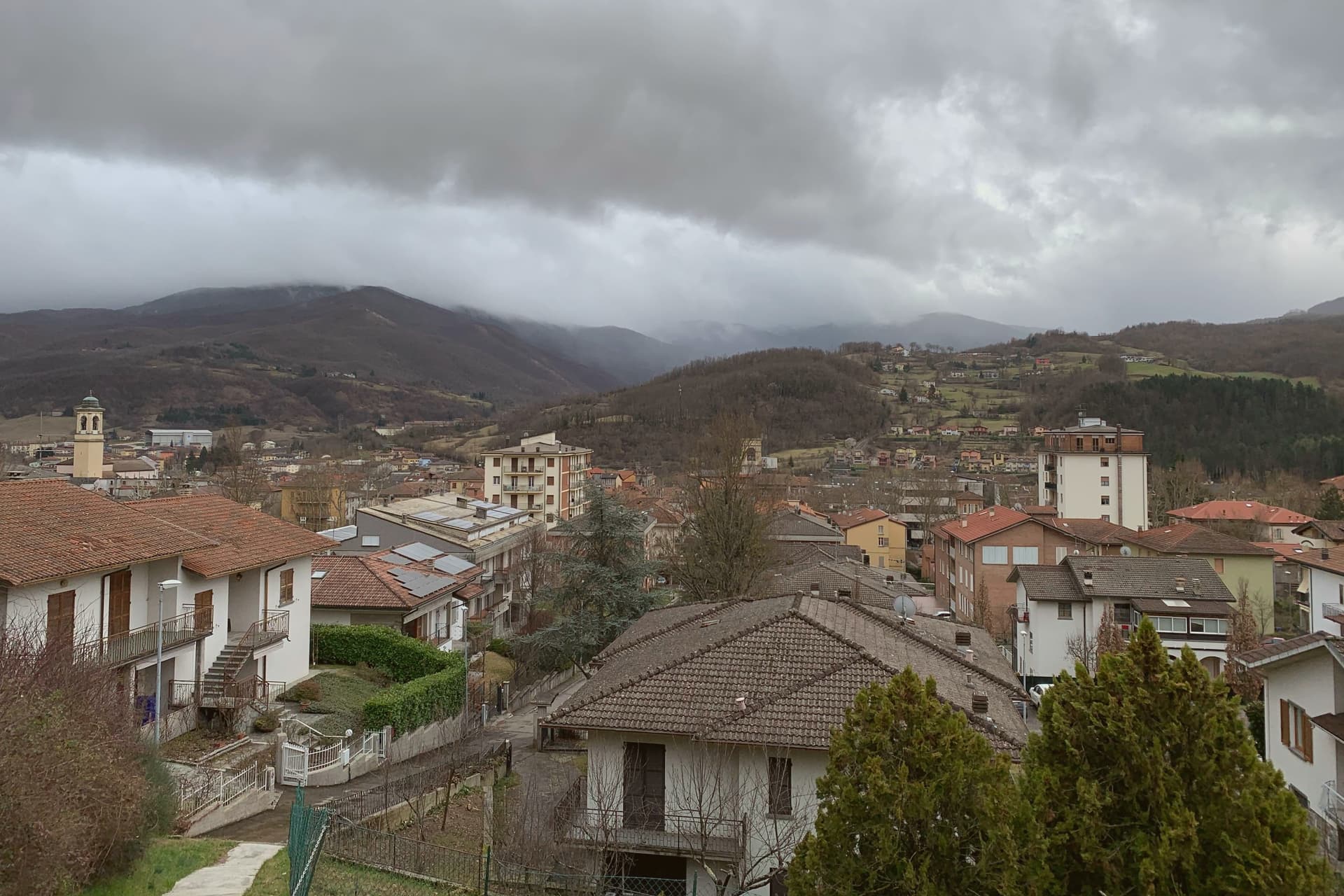
Borgo Val di Taro
Province: Parma · 411 m
The Cittaslow capital of the upper Taro valley at 411 meters, where the Fungo di Borgotaro IGP porcini has been protected since 1996.
Brisighella
Province: Ravenna · 115 m
A Lamone-valley borgo at 115 meters under three selenite hills crowned by a fortress, a clock tower, and a sanctuary.
Busseto
Province: Parma · 40 m
A 40-meter town where Giuseppe Verdi grew up, with a 300-seat opera house in the Rocca he refused to enter.
Canossa
Province: Reggio nell'Emilia · 219 m
The Reggiano commune holding the ruined castle where an emperor stood three days in the snow to beg forgiveness in 1077.
Castel San Pietro Terme
Province: Bologna · 75 m
A 75-meter thermal town east of Bologna, its sulphurous waters in use since 1137.
Cervia
Province: Ravenna · 2 m
The Adriatic salt town with 827 hectares of working saline, planned in 1697 around a grid of salt workers' houses.
Cesenatico
Province: Forlì-Cesena · 3 m
An Adriatic fishing port whose canal was redrawn on commission from a Borgia patron, with ten historic sailboats moored as a floating museum.
Collecchio
Province: Parma · 112 m
A Parma-cintura town on the Via Francigena, known today for a dairy multinational's headquarters and a football club's training ground.
Faenza
Province: Ravenna · 34 m
The city that gave its name to faïence, with a tin-glazed maiolica tradition since the fourteenth century and the world ceramics museum since 1908.
Ferrara
Province: Ferrara · 9 m
A Renaissance capital planned on a grid rather than grown by accident, small enough to cross by bicycle in twenty minutes, and ringed by walls that still stand whole.
Gualtieri
Province: Reggio nell'Emilia · 22 m
A right-bank Po commune in the Reggiana lowlands, built around a hundred-meter-square arcaded piazza and the Bentivoglio palace that holds the Ligabue collection.
Imola
Province: Bologna · 47 m
Bologna's Romagna twin, a medieval brick centro anchored by the Caterina Sforza-fortified Rocca, with the Autodromo Enzo e Dino Ferrari (the Imola F1 circuit) wrapping the Santerno river at the southern edge of town.
Parma
Province: Parma · 57 m
A 57-meter Po-plain capital on the Via Emilia, where Correggio painted the Duomo dome and Parmigiano ages in vaults across the province.
Ravenna
Province: Ravenna · 4 m
A 4-meter coastal capital of three successive empires, with eight UNESCO mosaic monuments from the fifth and sixth centuries.
Santarcangelo di Romagna
Province: Rimini · 42 m
A Via Emilia hill town on the Marecchia plain, with over 150 tufa caves under the centro and a Malatesta fortress on its summit.
Sasso Marconi
Province: Bologna · 128 m
A 128-meter pre-Apennine town at the confluence of the Setta and Reno, renamed in 1938 for the radio pioneer whose family estate stands in its Pontecchio frazione.
Vignola
Province: Modena · 125 m
The cherry-and-castle town on the Panaro at 125 meters, where a fortress and a self-supporting 1500s spiral staircase mark the skyline.
From elsewhere in Italy
Five more towns
Valeggio sul Mincio
Province: Verona
A moraine-hills town at 88 meters between Garda and Mantua, with a 1393 Visconti bridge-dam over the Mincio and a tortellino called the love knot.
Lama dei Peligni
Province: Chieti
A 669-meter Majella village known for chamois, the Cavallone cave, and a prehistoric burial dug from Fonterossi dated 7000 to 5000 BC.
L'Aquila
Province: L'Aquila
The regional capital at 721 meters, founded by Frederick II around 1240 and still reconstructing after the 2009 earthquake.
Martina Franca
Province: Taranto
A Baroque and Rococo town on the Itria ridge at 431 meters, with an opera festival in its ducal courtyard since 1975.
Acquasanta Terme
Province: Ascoli Piceno
A sulphur-spring spa at 392 meters in the upper Tronto valley, where the water still surfaces at 30 degrees.