
To eat well
Where to eat well in Puglia
30 towns
Towns holding at least one place a guide put its name to. The ones several guides agree on come first.
The towns
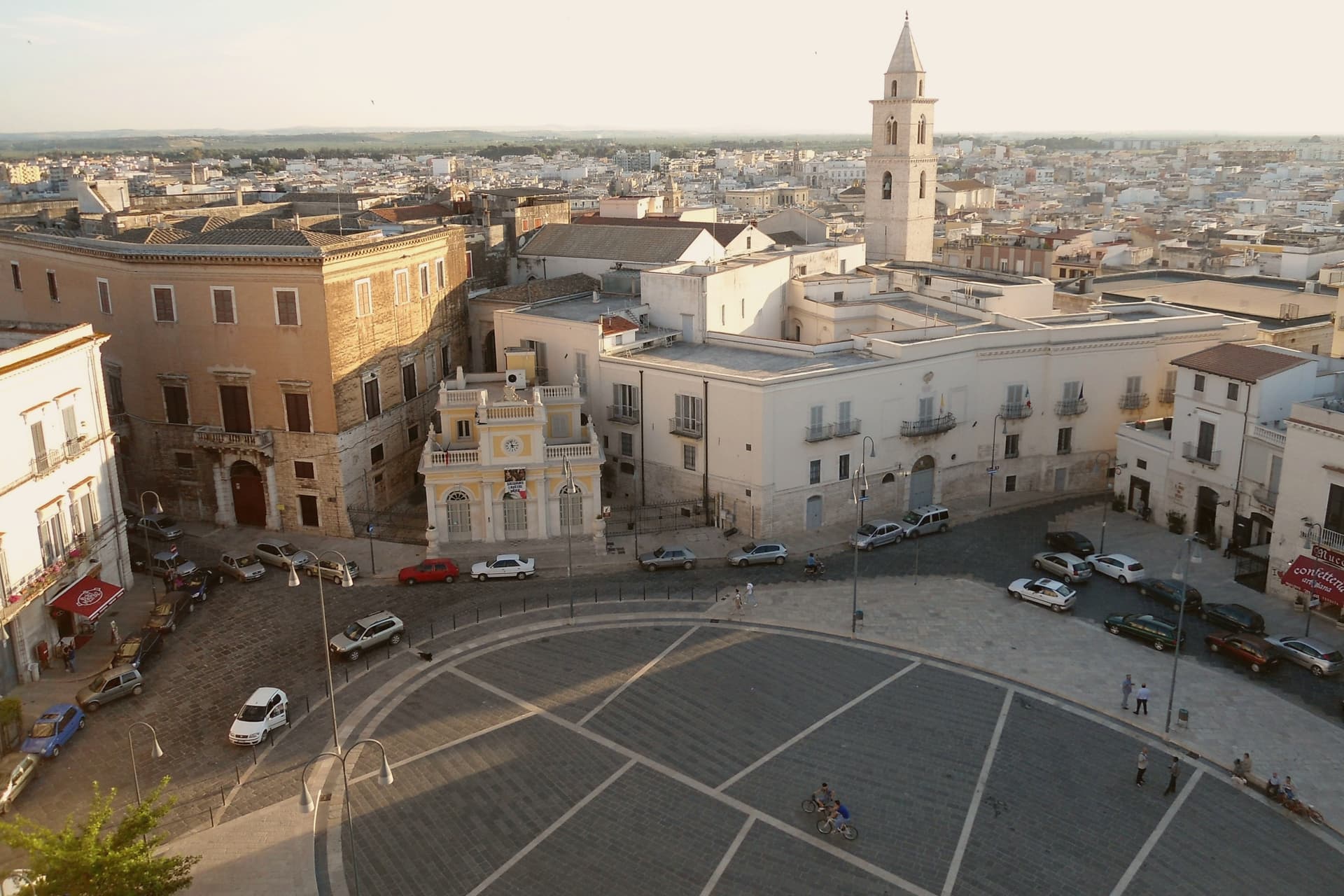
Andria
Province: Barletta-Andria-Trani · 151 m
The city Frederick II carved in stone as his faithful Andria, the birthplace of burrata, ruling the Murge plateau eighteen kilometers north of its most famous castle.
Putignano
Province: Bari · 372 m
Putignano has run its carnival continuously since 1394, the longest unbroken run in Europe, staged in a Murgia town with a karst cave threaded beneath its own centro storico.
Lecce
Province: Lecce · 49 m
The Baroque capital of the Salento, ninety-four thousand people on the Lecce-stone plain, carving its façades in honey limestone since 1500.
Trani
Province: Barletta-Andria-Trani · 7 m
The Adriatic port whose pink-white Romanesque cathedral stands on the water, built for a Greek pilgrim who died here in 1094.
Polignano a Mare
Province: Bari · 24 m
The Adriatic cliff town thirty kilometers south of Bari, built on a twenty-metre limestone bluff, birthplace of Domenico Modugno.
Carovigno
Province: Brindisi · 161 m
An upper Salento hill town between Brindisi and Ostuni, with a marine reserve on its coast.
Minervino Murge
Province: Barletta-Andria-Trani · 445 m
A ridge town at 445 meters where the Murgia plateau breaks off into open view, inside the national park that carries its name.
Ostuni
Province: Brindisi · 218 m
The Città Bianca on three hills at 218 meters, eight kilometers inland, whitewashed against the Murge above an Adriatic plain of olive trees.
Manduria
Province: Taranto · 79 m
The Messapian capital thirty-five kilometers east of Taranto, ringed by three concentric stone walls and the home of Primitivo.
Monopoli
Province: Bari · 9 m
An Adriatic walled town forty kilometers south of Bari, the Charles V castle on the headland, 156 square kilometers of coastline behind it.
Vieste
Province: Foggia · 43 m
The Gargano headland of whitewashed alleys on a white limestone cliff, with the 25-meter Pizzomunno sea stack standing on the beach.
Fasano
Province: Brindisi · 118 m
A Brindisi-province town running from the Adriatic up to the Itria escarpment, holding a Roman coastal city, a wooded highpoint, and one of Europe's largest safari parks.
Martina Franca
Province: Taranto · 431 m
A Baroque and Rococo town on the Itria ridge at 431 meters, with an opera festival in its ducal courtyard since 1975.
Otranto
Province: Lecce · 20 m
Italy's easternmost city, eighty kilometers from Albania, with a Norman mosaic floor and the bones of 813 martyrs in the cathedral.
Peschici
Province: Foggia · 91 m
A Gargano cliff-top village above the Adriatic, white houses spilling toward the sea and trabucchi on the headlands.
Monte Sant'Angelo
Province: Foggia · 843 m
The Gargano peak at 843 meters, the oldest western shrine to an archangel, UNESCO since 2011.
Alberobello
Province: Bari · 402 m
The Itria valley town built entirely of trulli, 1,500 corbelled limestone cones in two quarters, UNESCO since 1996.
San Severo
Province: Foggia · 86 m
The Daunia wine capital on the Tavoliere, home to Puglia's first DOC of 1968 and a May festa of firework batterie known across the south.
Oria
Province: Brindisi · 166 m
A Messapian acropolis between Taranto and Brindisi crowned by Frederick II's triangular castle, home to one of medieval Europe's oldest Jewish communities.
Galatina
Province: Lecce · 78 m
The Salento town at 78 meters where the cult of San Paolo bred tarantism and gave the pizzica its origin myth.
Giovinazzo
Province: Bari · 7 m
An Adriatic fishing port twenty kilometers northwest of Bari, with a Norman cathedral and a Bronze Age dolmen in the agro inland.
Ugento
Province: Lecce · 108 m
A Messapian-Roman town five kilometers from the Ionian, where a Baroque castle sits on the walls of the ancient city of Ozan.
Bovino
Province: Foggia · 646 m
A Daunian Mountains hill town at 646 meters above the Cervaro valley, Roman Vibinum, with a Norman-Swabian castle later turned into a Guevara ducal palace.
Conversano
Province: Bari · 219 m
A pre-Murge hill town at 219 meters, three centuries seat of the Acquaviva counts, with the abbey-monastery once called the Wonder of Puglia.
Corigliano d'Otranto
Province: Lecce · 95 m
A Griko-speaking town twenty-five kilometers south of Lecce, built around a 1500s Lecce-stone castle of circular towers around a quadrangular plan.
Giurdignano
Province: Lecce · 78 m
A two-thousand-resident Salento borgo at 78 meters known as the megalithic garden of Italy, with nineteen menhirs and a cluster of dolmens.
Mattinata
Province: Foggia · 75 m
The only Apulian town that faces south on the Adriatic, the white amphitheater of the eastern Gargano beneath Monte Sacro.
Melendugno
Province: Lecce · 36 m
Salento's archaeological-beach comune: 17 km of Adriatic coast in Lecce province combining karst pools, Bronze-Age-to-Messapian ruins, and a run of blue-flagged sand.
Vernole
Province: Lecce · 38 m
A Salento commune ten kilometers from Lecce whose frazione of Acaya is the only Renaissance fortified town in southern Italy.
Vico del Gargano
Province: Foggia · 445 m
A Gargano hill town at 445 meters where a Norman castle, a kiss alley, and DOP citrus terraces step down toward the Adriatic.
From elsewhere in Italy
Five more towns
Menfi
Province: Agrigento
Sicily's triple-signal western coast town: 11,800 residents on a low ridge above 9 km of protected sand at Porto Palo, backed by cellars and olive groves that between them carry Italy's three major small-town quality marks.
Cogne
Province: Aosta Valley
The mining town turned capital of the Gran Paradiso, the Aosta Valley's largest commune with 95 percent of its land inside Italy's oldest park.
Velletri
Province: Roma
The Castelli Romani town where Augustus grew up, and the home of its own Velletri DOC wine since 1972.
Guardia Perticara
Province: Potenza
The stone village at 678 meters above the Sauro valley, rebuilt block by block in Gorgoglione sandstone after the 1980 earthquake.
Cison di Valmarino
Province: Treviso
A Prosecco hills borgo at 261 meters under the dolomite rock of CastelBrando, the largest inhabited castle complex in Europe.